MetriCup Guide
Are You Growing Your Coffee Shop or Just Getting Lucky?
 Rich Manalang
Revenue going up is a good sign. But it doesn't tell you whether you're building something durable or running on a treadmill that never stops.
Two very different ways to grow
Coffee shop revenue can grow two ways: you bring in more new customers, or your existing customers come back more and spend more. Both show up as revenue growth. Only one of them is sustainable without continuous marketing spend.
A shop where 75% of revenue comes from returning customers is fundamentally different from one where 75% comes from new customers. The first has a loyal base that keeps showing up. The second has to win new customers constantly just to stay flat — and any slowdown in new customer acquisition means revenue drops immediately.
The benchmark: returning customers should drive most of your revenue
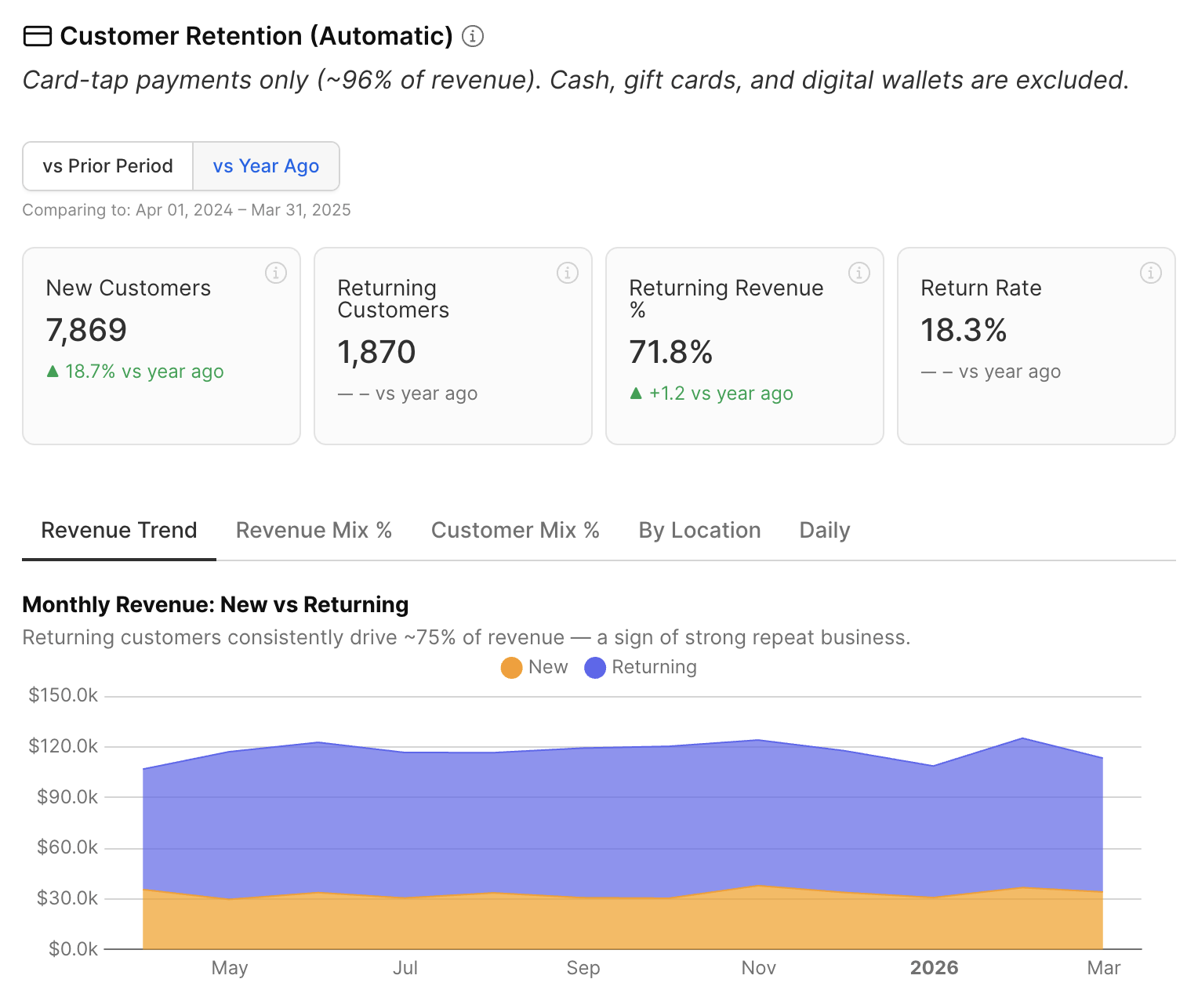
Healthy specialty coffee shops typically see returning customers drive around 75% of total revenue. That number isn't a hard rule — a new location will naturally skew toward new customers until it builds a regular base — but it's a useful signal.
If your returning revenue share is well below 75%, you either have a retention problem (people try you and don't come back) or you're in an early growth phase where the customer base hasn't had time to solidify. Knowing which one it is changes how you respond.
You can track this without a loyalty program
Most coffee shop owners assume you need a loyalty app to track customer retention. You don't. The vast majority of transactions — around 96% of revenue at card-accepting shops — are paid by card. And every card has a unique fingerprint.
By tracking card fingerprints across transactions, you can classify every card-tap as New (first time we've seen this card) or Returning (card has been here before), with no loyalty app enrollment required. Customers don't have to do anything. You just get the data.
This gives you a surprisingly clear picture of your actual customer base — how many unique customers you have, how often they return, and what share of revenue each group drives.
What to look for
Returning revenue share is declining
You're either losing regulars or not converting new visitors into repeat customers. Dig into what changed — staffing turnover, a product that was discontinued, a price increase, or a new competitor nearby.
New customer count is growing but returning share is flat
Your marketing is working but retention isn't. New people are finding you and not coming back — a product, experience, or expectation mismatch. Fixing retention is almost always cheaper than increasing new customer acquisition.
Both new and returning counts are growing
Genuine growth. New customers are finding you and staying. This is the pattern you're building toward — a compounding base that grows without requiring you to constantly outspend on acquisition.
The loyalty program question
A loyalty program can help retention, but it's not a substitute for understanding retention. If your returning customer share is low, a loyalty program won't fix the underlying problem — it'll just give you a list of people who still aren't coming back, now with names attached.
Start by knowing your baseline. How many of your customers are regulars? What percentage of revenue do they represent? How has that changed over the last year? Once you know the answer, you'll know whether a loyalty program makes sense and what problem it's actually solving.
MetriCup
See your new vs. returning split automatically
MetriCup uses card fingerprinting to classify every transaction across all your locations — no loyalty app required. See your returning revenue share, return rate, and customer trends updated daily.
Get early access