MetriCup Guide
How to Staff Your Coffee Shop Smarter: Weather, Holidays, and the Data Behind the Schedule
 Rich Manalang
Most coffee shop schedules are built on last week's schedule, adjusted by gut feel. Here's what a data-driven approach actually looks like — and why it works differently for every location.
The problem with scheduling from habit
Most scheduling decisions look like this: copy last week, add a person on Saturday, pull someone off Monday, done. It's fast and it feels reasonable. But it compounds errors over time. If last week was overstaffed on Wednesday, this week will be too. And it ignores everything you actually know about next week — the weather forecast, the holiday, the local event.
The good news is that most of what drives demand variability is predictable. You just need the right framework.
Start with the baseline: what does a normal day look like?
The first question to answer is: how much does this store typically sell on this day of the week? Not last Tuesday specifically — the median of the last four non-holiday Tuesdays.
The median matters more than the average here. If one of those Tuesdays had an unusually large catering order, the average would skew high and your staffing model would chase a number that doesn't reflect normal Tuesday demand. The median ignores that outlier.
Once you have the baseline, you know what "a normal day" costs in labor hours. Everything else is an adjustment to that number.
Holidays hit every location differently
This is the insight most owners get wrong. When a holiday is coming up, the instinct is to either treat it like a normal day or cut hours across the board. But the same holiday can mean completely opposite things depending on where your store is.
An office-district café on Presidents Day might lose 80% of its sales — nobody's at work, so the morning rush simply doesn't happen. A residential neighborhood café on that same day might see a 30% increase — everyone's off work and wants to get out of the house.
If you apply a single blanket holiday policy across both locations, one will be catastrophically overstaffed and the other will be overwhelmed. The right approach is to calculate holiday adjustment factors per location, based on that store's own historical data on that specific holiday.
Example
Office-district café, Presidents Day: −81% vs normal Monday
Residential café, Presidents Day: +34% vs normal Monday
Same holiday. Same city. Opposite staffing needs.
Weather is more predictable than you think
Rain affects coffee shop traffic — but not equally for every store. A walk-up café with outdoor seating might see 20-25% lower sales on a rainy day. An indoor café with a drive-through or covered entrance might barely notice.
The key is that these sensitivities are learnable from your own historical data. Look at rainy days over the past year, compare sales to your typical same-day-of-week average, and you have your store's rain sensitivity factor. Do the same for clear days, cloudy days, and extreme heat.
Once you know each store's weather sensitivity, a 14-day weather forecast becomes a 14-day demand forecast. And a demand forecast becomes a staffing plan.
Putting it together: a three-layer model
The most effective approach to coffee shop forecasting builds up in layers:
- Baseline — median of the last four same-day-of-week sales, excluding holidays
- Holiday adjustment — per-location factor based on historical performance on that specific holiday
- Weather adjustment — per-location sensitivity factor applied to the forecast conditions
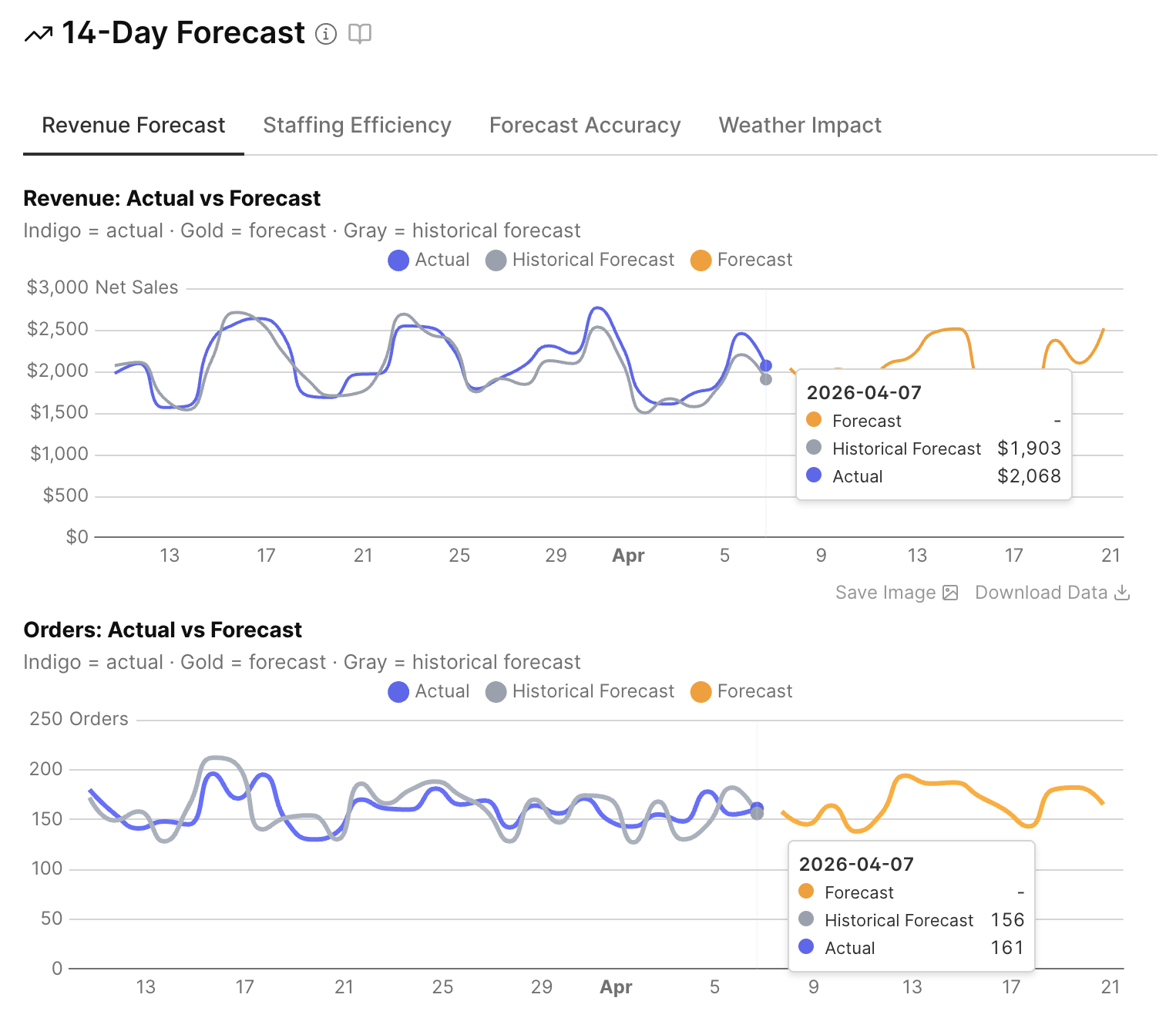
Each layer is a multiplier on the previous one. The result is a predicted revenue number for each day, per store. From that, you divide by your store's target SPLH to get recommended staffing hours.
Formula
Predicted Sales = Baseline × Holiday Factor × Weather Factor
Recommended Hours = Predicted Sales ÷ Target SPLH
What the model can't predict
A forecast is a starting point, not a guarantee. It won't know about the street fair two blocks away, the power outage that closes you early, or the viral social media post that sends 300 people to your door on a Tuesday. When those things happen, the model will miss — and that's expected.
Use the forecast as a baseline that your experienced managers adjust with their on-the-ground knowledge. The goal isn't to replace judgment — it's to give judgment a better starting point than last week's schedule.
MetriCup
14-day forecasts built into your dashboard
MetriCup calculates per-location forecasts using your historical data, per-store holiday factors, and weather conditions — with recommended staffing hours built right into the forecast table.
Get early access